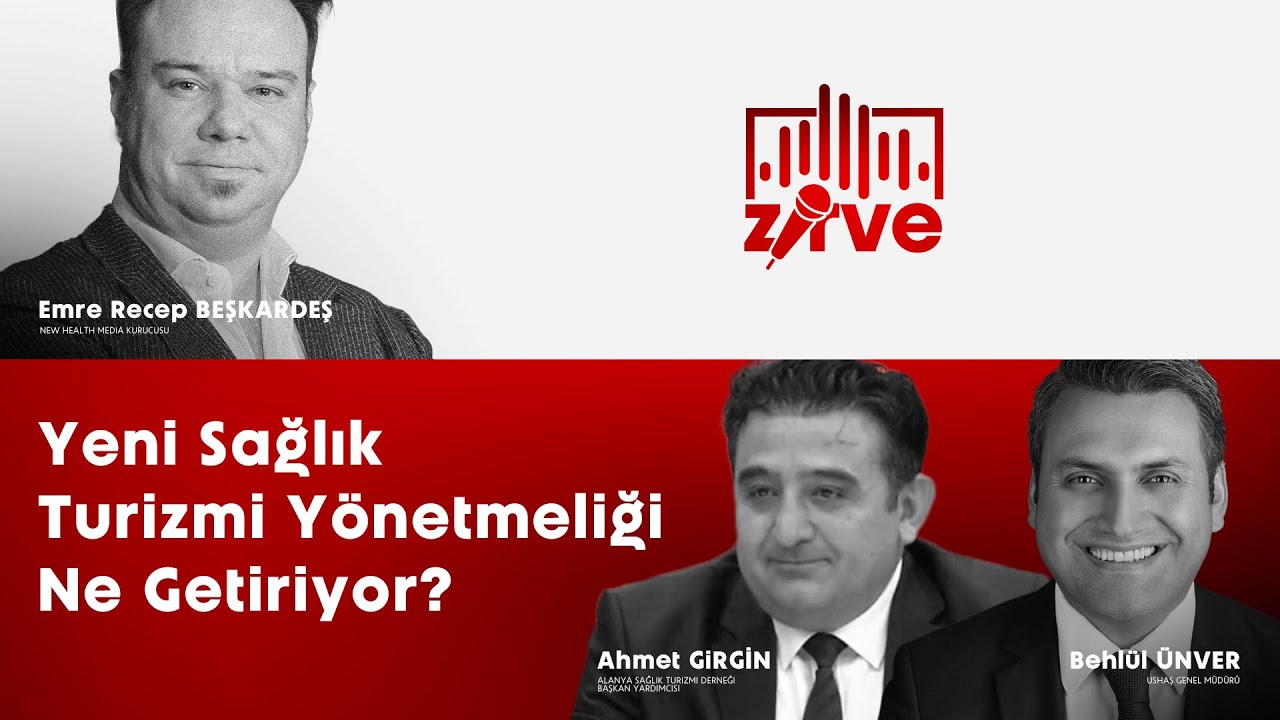
Together with USHAŞ General Manager Behlül Ünver and Alanya Health Tourism Association Vice President Ahmet Girgin, we put the new health tourism regulation published on April 26 on the table. We discussed not just the articles, but the vision. Many issues in the health tourism sector that have been discussed for years in the field, in institutions, and on screens without ever reaching a resolution came back onto our agenda with the new regulation published on April 26, 2025. I see this important change not merely as an "official document," but as a concrete indicator of where Turkey has arrived in health exports and the direction it is heading.
That is why, on our Zirve program ("Zirve" means "summit"), recorded at the Kanal V studios in Antalya, we came together with the two most critical actors in this process:
USHAŞ General Manager Behlül Ünver and
Alanya Health Tourism Association Vice President Ahmet Girgin.
We wanted to talk about more than the regulation itself — to address not only the rules but the state vision behind them, the reflexes in the field, and the turning points for the sector.
This Regulation Is Not Just a Document, It Is a Change of Direction
As Behlül Ünver emphasized, this regulation is not merely an "update." Turkey is now moving from price competition to a quality-focused model in health tourism. This is a critical turning point for the future of our sector.
In the new era, the question on the table is no longer just "how do we bring in patients?" but "how do we build a sustainable, ethical system that is recognized on a global scale?"
A Change Shaped by Feedback from the Field
Another important point I highlighted on Zirve was this: this regulation was shaped not at a desk, but by feedback coming from the field.
The problems Ahmet Girgin witnessed first-hand in the field were brought to the public authorities with USHAŞ's guidance, and the regulation was revised with this multi-layered data.
I would like to recall some of the standout changes here:
- The 5-year seniority requirement for dentists was removed.
- The required number of foreign-language-speaking staff at health facilities was reduced from 2 to 1.
- TÜSKA accreditation became mandatory for medical centers and hospitals.
- Membership in the Heal Türkiye platform was made a requirement.
- USHAŞ will now steer the sector as a regulatory body.
All these changes were designed not merely as "simplification" but also to function as a quality filter.
Heal Türkiye: Not Just a Platform, but a Shield of Trust
Another topic I particularly highlighted on the program was the position of the Heal Türkiye platform. We now appear before patients abroad with a single reference system. This platform is not just a listing space; it will be the assurance of Turkey's health brand security.
Moreover, thanks to this structure, a stronger monitoring system will be established against under-the-counter operations. Patient satisfaction, performance criteria, and the reputation of institutions will be managed through this system.
We Must Take Sectoral Concerns Seriously, but Not Miss the Big Picture
I know there are different interpretations, criticisms, and concerns rising from the field about every article discussed on Zirve. But I can say this very clearly:
This regulation does not have to be perfect, but it was necessary.
Because the system had to be updated while in motion.
As USHAŞ also said, every step that could "grow the under-the-counter market" will be watched carefully. That is why the regulation is not fixed, but a living structure. It can be revised with feedback, and this sectoral participation is itself a value in its own right.
The Real Purpose of Zirve
My purpose in making this program was not only to inform the public. I wanted to help those who steer the sector, the decision-makers, and everyone working hard in the field build a common language.
In this sense, Zirve was more than a television program: it was a policy discussion space, a ground for drawing a roadmap.
A More Corporate, More Transparent, More Secure Health Tourism
The new regulation tells us this:
We now need to write stories of institutional trust, not individual success stories.
Turkey's growth in health tourism will be possible not just through numbers, but through:
- Accountability,
- International recognition, and
- Sustainable quality.
I would like to once again thank everyone who had a voice, a say, and took responsibility in this process.
I hope Zirve serves as a guide for the sector and helps steer the way through this new regulatory era.